|
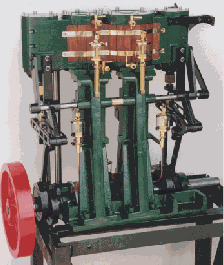
Compound steam engines use two or more cylinders to allow
the steam to expand, beginning at the input pressure and ending at the
exhaust pressure, in two or more stages. Compounds are referred
to by the number of stages of expansions that the steam undergoes.
Most common is the double compound simple referred to as a
compound steam engine. These consist only of a high pressure and
a low pressure cylinder. Triple or quadruple compounds may have
three or four cylinders, respectively, or, to keep the size of the low
pressure cylinders practical, two lower pressure cylinders. Thus
a triple expansion engine may have four or five cylinders-one high, one
or two intermediate, and two low pressure.
We are familiar with the problems caused by condensation of the steam
as it passes from the boiler through the engine. Condensation
takes place as the steam enters the steam chest and cylinder.
Most noticeable is sufficient condensation so as to cause knocking in a
cold engine or even a broken crank, connecting rod, or loosening of the
bolts holding the supports to the engine base. These are severe
cases, but ones we see far too frequently.
After the engine heats up, condensation of the incoming steam is
lessened but continues, because of the fact that as the steam expands
during the power stroke, its temperature drops. It must drop
because the expanding steam occupies more space as it expands and the
molecules which comprise the steam must now occupy more space, are more
widely separated and hence the heat is distributed over more and more
volume. As such, the temperature drops. If you wish to
know, this is an adiabatic expansion, i.e. expansion to which no
heat is added or removed.
So we see that in a simple engine, the temperature range goes from the
extreme hot steam (direct from the boiler) to the lower temperature
steam which becomes the exhaust. This lower temperature steam
cools the metal of the cylinder preparing the scene for the cold shock
to the hot steam entering and resultant condensation of the incoming
steam.
On way to avoid the magnitude of this shock is to allow the steam to
expand only partially, thus the end temperature will be higher, the
metal of the cylinder will remain warmer, and the condensation of the
incoming steam will be less. To continue to derive work from this
intermediate steam, it is passed into a next larger cylinder where the
expansion is completed and the ultimate (exhaust) temperature reached.
Thus the difference between the input and output temperature of the
steam in each cylinder is roughly half that if only a single cylinder
is used. The relative sizes of the pistons are arranged so that
each performs approximately one-half of the work. Triples and
Quads are designed to divide the work into three and four equal
portions.
|
|