|
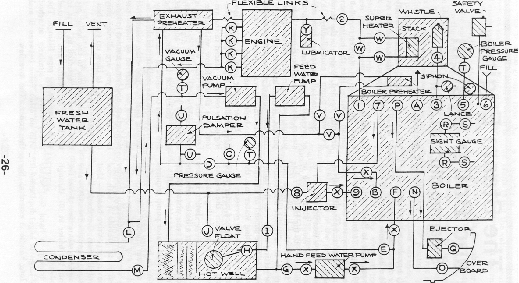
Some much-needed auxiliary items are
the vacuum (pressure) gage and the
vacuum pump; the feed water (pressure) gage between the feed water pump
and the boiler; and the check valve (X) just before the boiler valve
(B). Note that if this valve is omitted the pressure gage will
read the boiler pressure, and provide incorrect information about the
performance of the engine feed water pump.
The boiler blow-down (N) and the output of the steam ejector are led
through the boat hull via seacocks (O) and (Q). A pipe is led
from the bottom of the ejector to the compartment to be drained.
The boiler fill (6) is a standard 3/4" garden hose fitting which is
very useful for initial filling of the boiler. Never use when
boiler is pressured! The boiler
pressure gage is protected from steam by the siphon (W) and petcock (T)
which, like all gage petcocks, is just cracked open.
Auxiliary boiler valve (3) delivers steam to the whistle which has its
own quick-acting whistle valve (4) and for the steam lance control
valve. The stack blower is controlled by valve (a).
Sizes have been provided for all valves on the assumption that our
system is 3 to 10 hp on a boat 18 to 28 feet. Most of the piping
may be carried out using standard 1/2" pipe and fittings with the
exception of close nipples and places where mechanical failure by
vibration, shock, or a simple hip blow may result in failure. In
most instances, the high pressure line should be done using
schedule 80. Most certainly schedule 80 should be used between
the boiler and the first valve in every line. Engine exhaust
ought to be 1" pipe down to the 3/4" copper pipe condenser thus
avoiding back pressure; 1/4" or 3/8" copper tubing is good from
the
condenser to the vacuum pump.
Most of the rest of the piping can be a mixture of pipe and
1/2" copper tubing, the latter connected using flare, NOT compression
fittings. The blow-down line should be as large as the boiler
fitting, generally 3/4". Running the whistle line up inside the
stack prevents condensation in the whistle line. Attach the
whistle to the stack.
Piping should be installed longitudinally and thwartships, not point to
point. Copper tubing should be formed using tubing benders, not
by hand, which produces bumps and flat spots.
|
|