|
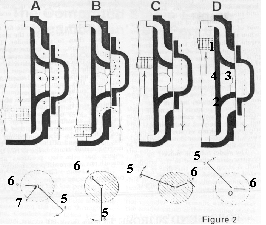
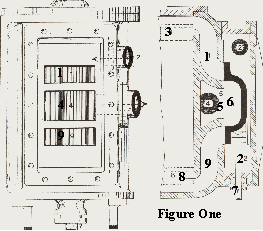
1. Top steam port 2.
Bottom steam port
3. Slide Valve
4. Exhaust port
5. Crank position 6. Eccentric
position 7. Crankshaft
A Steam release on piston, down
stroke begins.
B Steam lead begins to lower face of piston.
C. Steam cut-off on piston up stroke.
D. All ports closed to give compression very near stroke end.
If the width of the cylinder port openings and the thickness of the
valve ends are the same, the valve will open one steam port to steam
and the other to exhaust for even the slightest movement of the valve
from a central position. This does not allow expansive
working. To overcome this, the width of the valve edge is made
greater than the steam port width. This extra width is known as
an outside lap (or, steam) lap and inside (or, exhaust) lap.
The admission of steam to either end of the cylinder then only begins
when the valve has moved a distance equal to the outside lap and
exhaust from the other end of the cylinder begins when the movement is
greater than the inside lap and continues until the valve has again
returned to this position. By this means steam is cut off before
the full stroke allowing it to work by expansion and is not exhausted
until towards the end of the stroke. Ideally the exhaust is
closed just before the end of the stroke to provide a cushion of steam
against which the piston can slow down and reverse direction.
The slide valve is moved by an eccentric disc attached to the
crankshaft. A strap around this disc is connected to the slide
valve by the slide rod having a knuckle in it. Simply: the
maximum throw of the eccentric is a quarter of a revolution ahead of
the crank to put the valve in mid position when the piston is at the
end of the stroke.
In practice, it is desirable for the steam to have free entry to the
steam port and then to the cylinder. The port, therefore, has to
be opened slightly by the time the piston stroke begins. To this
end, the eccentric is set slightly ahead of a 90 degree position.
This is known as the angular advance. Additionally this angular
advance provides the "cushion" noted above.
An engine as described above running slowly may stop at times when the
inconing steam and exhaust act simultaneously. For this reason,
steam engines are fitted with heavy flywheels. to assist them over this
point
|
|